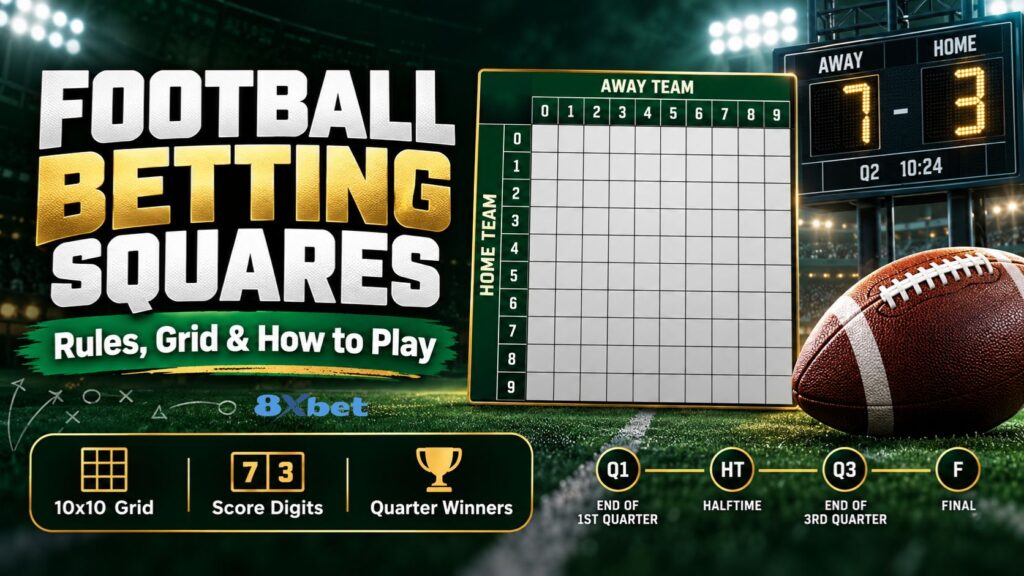
Football game betting squares is a score-based prediction game played on a 10×10 grid containing 100 squares. Each square is assigned two numbers, one for each team, and the winner is determined by matching those numbers with the last digit of each team’s score at the end of a specified period.
The game is especially popular during the NFL Super Bowl in the United States, where it is commonly called Super Bowl Squares, football squares, football boxes or a football squares pool.
For example, suppose the Kansas City Chiefs lead the Philadelphia Eagles 17-10 at halftime. The winning square is the one showing 7 for the Chiefs and 0 for the Eagles, because those are the last digits of their respective scores.
You do not need to predict which team will win the match. Your square only needs to match the score digits at the relevant checkpoint.
For Nigerian readers, there is one important distinction: football squares are mainly associated with American football, not the usual football betting markets for Premier League, Champions League or NPFL matches.
This guide explains how football betting squares work, how to read a 10×10 grid, the rules for determining winners, common payout structures and what happens when a game goes into overtime. It also covers the best numbers, frequently misunderstood rules and practical examples using naira.
What Are Football Betting Squares?
Football betting squares are a grid-based game in which participants claim squares representing combinations of the final digits of two teams’ scores.
The standard game uses:
- One 10×10 grid with 100 squares.
- Two American football teams, one assigned to each axis.
- Numbers 0 through 9, randomly assigned to both axes.
- One or more participants claiming squares.
- Winning checks at the end of each quarter, including the final score.
- A predetermined method of recognising winners or distributing prizes.
The game can be organised as a free contest or, where legally permitted, a paid pool with a shared prize fund.
Unlike ordinary sports betting, football squares do not require participants to select a match winner, point spread or total points.
The winning result is determined by the last digit of the teams’ cumulative scores at agreed checkpoints.
Why Is It Called Football Squares?
The name comes from the square-shaped boxes on the grid.
With ten rows and ten columns, there are 100 possible combinations of single-digit score endings.
Each square represents one combination.
For example:
- 7-0 means the first team’s score ends in 7 and the second team’s score ends in 0.
- 3-4 means their scores end in 3 and 4.
- 0-0 means both scores end in 0.
The full score does not need to match these numbers exactly. Only the final digit of each team’s score matters.
That means 17-10, 27-20 and 37-30 all produce the same winning digit combination: 7-0, provided the teams appear in the same order.
How Does Football Squares Betting Work?
Football squares betting works by randomly connecting every grid position to a pair of score digits and checking the official scoreboard at the end of each selected period.
The traditional process is straightforward.
Step 1: Create a 10×10 Football Squares Grid
Draw a grid containing ten columns and ten rows.
This gives you:
10 × 10 = 100 squares.
Add one American football team above the columns and the other beside the rows.
For example, you could put the Kansas City Chiefs across the top and the Philadelphia Eagles down the left side.
Initially, leave the number labels blank.
The board should have 100 claimable boxes, with separate spaces for assigning the numbers later.
Step 2: Let Participants Claim Squares
Participants choose one or more unclaimed boxes.
Their names or initials are recorded inside those boxes.
Imagine a group of friends in Lagos arranging a free Super Bowl prediction contest.
Tunde claims three squares, Ada claims two and the remaining squares are assigned among the other participants.
At this stage, nobody knows what score digits their positions will receive.
This is important for fairness.
Participants should normally claim their squares before the numbers are randomly assigned.
Otherwise, someone choosing later could deliberately select historically favourable digits.
Step 3: Randomly Assign Numbers From 0 to 9
Once the board is complete, randomly arrange the digits 0 through 9 across the top.
Repeat the process independently down the side.
Each digit must appear exactly once on each axis.
For example, the top row could receive:
7, 2, 0, 9, 4, 1, 8, 5, 3, 6.
The left column could receive:
3, 8, 0, 6, 1, 5, 9, 2, 7, 4.
These are merely example arrangements.
Every grid position now corresponds to one pair of numbers.
A participant whose square is at the intersection of Chiefs 7 and Eagles 3 owns the 7-3 combination.
Once the draw is complete, the numbers and ownership should normally be locked for the duration of the game.
Step 4: Follow the Game Score
The participants watch the actual American football match.
Under standard football betting squares rules, winners are checked after:
- The first quarter.
- The second quarter, also called halftime.
- The third quarter.
- The final score.
The exact prize checkpoints should be agreed in advance.
Step 5: Check the Last Digit of Each Score
Suppose the Kansas City Chiefs lead the Philadelphia Eagles 14-7 after the first quarter.
Take the last digit of each score:
- Chiefs: 14 becomes 4.
- Eagles: 7 remains 7.
The winning square is Chiefs 4, Eagles 7.
Whoever owns that square wins the first-quarter prize, if a prize was established for that checkpoint.
Step 6: Repeat at Each Scoring Checkpoint
The same process is repeated at halftime, after the third quarter and at the end of the game.
The scores used are the teams’ cumulative totals, not simply the points scored during the latest quarter.
A participant may win more than once if the same digit combination appears at multiple checkpoints and the pool rules permit repeat winners.
How to Read a Football Betting Squares Grid?
The easiest way to understand a football squares grid is to follow one team’s score digit across the top and the other team’s digit down the side.
Where they intersect, you have the winning box.
Let’s use the Chiefs and Eagles again.
The small table below is an illustrative section of a larger 100-square board, not the complete 10×10 grid.
| Eagles ↓ / Chiefs → | 7 | 0 | 4 |
| 3 | Ada | Emeka | Sola |
| 0 | Tolu | Femi | Bisi |
| 7 | Zainab | Ngozi | Chika |
Suppose the Chiefs lead 7-3 at the end of the first quarter.
The Chiefs’ digit is 7, and the Eagles’ digit is 3.
Find column 7 and row 3.
They intersect at Ada’s square.
Ada is the first-quarter winner.
If the score later becomes Chiefs 10-10 Eagles at halftime, the winning combination is 0-0.
That means Femi wins the halftime checkpoint.
The process never requires adding both scores together.
You simply use the final digit of each team’s score separately.
Football Betting Squares Example: Four Quarters and Four Winners
Now let’s follow an entire hypothetical NFL game. The Kansas City Chiefs face the Philadelphia Eagles, and participants have already claimed their squares.
The grid numbers remain fixed throughout the game.
| Scoring checkpoint | Chiefs score | Eagles score | Winning digits | Example winner |
| End of Q1 | 7 | 3 | 7-3 | Ada |
| Halftime | 10 | 10 | 0-0 | Femi |
| End of Q3 | 17 | 13 | 7-3 | Ada |
| Final score | 24 | 20 | 4-0 | Bisi |
These results demonstrate three important football betting squares rules.
The Full Score Does Not Matter Beyond Its Last Digit
At the end of the first quarter, the score is 7-3.
At the end of the third quarter, it is 17-13.
Both checkpoints produce the same winning combination: 7-3.
The Same Square Can Win Twice
Ada’s 7-3 square wins both the first and third quarters.
Under a normal repeat-winner arrangement, Ada receives both prizes.
A pool may adopt different repeat-winner rules, but they must be established before the game.
The Match Winner Does Not Determine the Square Winner
The Chiefs win 24-20, but Bisi wins the final-score squares prize because Bisi owns the Chiefs 4, Eagles 0 combination.
Bisi did not need to predict a Chiefs victory.
The required result was the correct pair of final digits.
What Are the Official Football Betting Squares Rules?
There is no single governing rulebook for all private football squares pools. However, traditional Super Bowl squares games generally follow a recognised set of rules.
| Rule | Standard approach |
| Grid size | 10×10, containing 100 squares |
| Teams | One team per axis |
| Number assignment | Digits 0–9 randomly arranged on each axis |
| When numbers are drawn | After participants claim their squares |
| Winning condition | Last digit of each team’s score matches a square |
| Scoring checkpoints | Q1, halftime, Q3 and final |
| Number changes | Usually one fixed draw for the whole game |
| Repeat winners | Usually allowed |
| Overtime | Depends on the pool’s final-score rule |
| Payout distribution | Agreed before participation |
A well-organised pool should clearly publish these conditions before anyone claims a square.
In particular, participants need to know whether the final prize is determined at the end of regulation or after any overtime period. That single detail can change the winner.
How Are Football Squares Payouts Calculated?
Football squares payouts depend on the total prize fund and the percentage allocated to each checkpoint.
There is no universal fixed payout structure.
Some pools divide prizes equally among the four quarters. Others give a larger share to the final score.
Football Squares Payout Example in Naira
Suppose a hypothetical paid pool is legally permitted and contains:
- 100 squares.
- ₦500 per square.
- All squares claimed.
- No deductions or administrative fees.
The total collected would be:
100 × ₦500 = ₦50,000.
Now imagine the group chooses this payout distribution:
| Winning checkpoint | Share | Prize |
| First quarter | 20% | ₦10,000 |
| Halftime | 20% | ₦10,000 |
| Third quarter | 20% | ₦10,000 |
| Final score | 40% | ₦20,000 |
| Total | 100% | ₦50,000 |
The final-score winning square receives the largest prize.
This is an illustrative structure, not a mandatory payout rule or a verified 8XBET offer.
What if You Win Two Quarters?
Using the earlier hypothetical game, Ada owns the 7-3 combination. That square wins both the first and third quarters. If the pool pays ₦10,000 for each of those checkpoints, Ada receives:
₦10,000 + ₦10,000 = ₦20,000 gross prizes.
If Ada paid ₦500 for that one square and did not buy any others, the net gain would be ₦19,500.
However, the calculation would be different if Ada owned additional paid squares. It is important to distinguish gross prizes from actual profit after entry costs.
Can Football Squares Have Equal Payouts?
Yes. A group could divide a ₦50,000 prize fund equally across four checkpoints.
That would produce: ₦50,000 ÷ 4 = ₦12,500 per checkpoint.
Neither the equal-split system nor the 20/20/20/40 arrangement changes the method used to identify the winning square. Only the prize distribution changes.
What Are the Best Numbers for Football Betting Squares?
Historically, 0, 7 and 3 are among the more favourable last-score digits in NFL football squares, although the exact rankings depend on the scoring checkpoint and dataset.
The reason is connected to how American football points are awarded.
Under standard NFL rules:
- A touchdown earns 6 points.
- A successful kick after a touchdown adds 1 point.
- A field goal earns 3 points.
- A safety earns 2 points.
- A successful two-point conversion after a touchdown adds 2 points.
A touchdown followed by a successful extra-point kick commonly produces seven points.
A field goal produces three points.
These scoring patterns make certain final digits more frequent than others.
For instance, scores such as 7, 10, 14, 17, 20, 21, 24 and 27 regularly occur in American football.
Football Squares Number Categories
| Digits | General interpretation |
| 0 and 7 | Historically common NFL score endings |
| 3 and 4 | Also frequently encountered |
| 1, 6 and 8 | Possible through several scoring combinations |
| 2, 5 and 9 | Often less favourable, depending on the checkpoint |
These are broad historical patterns, not exact probabilities for an upcoming fixture.
Recent NFL score-digit studies also show that rankings differ between first-quarter scores and final scores.
Are 0-0 and 7-0 Good Football Squares?
They have historically been favourable combinations in many NFL datasets.
A 0-0 square can win when a checkpoint ends scoreless or when both cumulative scores end in zero.
A 7-0 square can win when the designated first team’s score ends in seven and the second team’s score ends in zero.
However, team order matters. Chiefs 7 and Eagles 0 is a different square from Chiefs 0 and Eagles 7.
There is another limitation: in a fairly organised traditional pool, participants choose their squares before the digits are drawn. You generally cannot choose a particular number combination in advance.
Do All 100 Squares Have an Equal Chance of Winning?
Before the numbers are randomly assigned, every unnumbered grid position has the same chance of receiving any particular digit pairing, assuming a fair draw.
For a single specified checkpoint, each unnumbered square therefore has a 1-in-100 chance of being assigned the combination that ultimately wins that checkpoint.
After the numbers have been assigned, however, the 100 digit combinations do not have equal historical probabilities of appearing in NFL scores.
That is because American football scoring follows specific point values.
This distinction explains why the square-selection process should be fair even though some completed number combinations are more favourable than others.
Football Squares vs Regular Football Betting: What Is the Difference?
Football squares and conventional sportsbook betting use different methods of determining winning outcomes.
| Feature | Football squares | Regular sportsbook betting |
| Main format | Shared grid or pool | Betting market with quoted odds |
| What you select | A square or allocated number pair | A specific event outcome |
| Winning condition | Last score digits match the square | Selected market conditions are satisfied |
| Prices | Entry fees or free participation | Bookmaker odds and accepted stakes |
| Typical payouts | Shared prize fund or predetermined award | Stake multiplied by accepted odds |
| Common context | NFL and Super Bowl contests | Football, basketball and other sports |
Football squares do not use decimal odds in the traditional pool format.
For example, a participant does not normally select Chiefs 7, Eagles 3 at bookmaker odds of 4.50.
Instead, a randomly numbered square may become the winning combination, and the prize is determined by the group’s rules.
For a different explanation of conventional bookmaker prices and potential returns, see our 8XBET betting odds.
Can You Play Football Betting Squares Online?
Yes. Football squares can be organised digitally without printing a paper grid.
An online squares board can allow participants to claim available positions, display randomised team numbers and identify winners from the official score.
Depending on the platform, additional features may include:
- Digital participant registration.
- Automatic number assignment.
- Shared links to the grid.
- Quarter-by-quarter score tracking.
- Winner notifications.
- Prize-pool calculations.
- Mobile-friendly grid access.
However, a website that provides a football squares board does not automatically have permission to operate real-money gambling in every jurisdiction.
Some online squares services provide only a board-management tool, leaving any prize administration to the organiser. Free-to-play versions may be available.
Can You Play Football Squares on Your Phone?
Yes, where a suitable mobile website or application is available.
A mobile user can generally open the shared board, view the available squares and follow the score.
For someone in Nigeria watching NFL games, a digital grid can be more convenient than exchanging photographs of a paper board through WhatsApp.
The board should clearly show both teams, all number labels and the owner of each square.
Participants should also be able to see the rules before joining.
Can Football Squares Be Used for Premier League or NPFL Matches?
A grid-based score prediction contest can be adapted to association football, but the traditional football squares game is designed around American football scoring.
In a Premier League or NPFL match, scores such as 1-0, 2-1, 0-0 and 2-2 are common.
Those scores are fundamentally different from NFL results such as 17-14 or 24-20.
A standard 10×10 digit grid would therefore behave very differently in association football, because many high-number score combinations would be exceptionally unlikely.
A modified football squares contest might recognise halftime and full-time scores, but that would be a custom version with different scoring checkpoints and probabilities.
For standard soccer betting, markets such as 1X2, Double Chance, Over/Under and Correct Score are much more relevant.
You can learn about those in our football betting guide and 1X2 betting guide.
What Happens if an NFL Football Squares Game Goes Into Overtime?
Overtime can change the winning combination for the final prize.
Suppose the score is tied 17-17 at the end of regulation.
The winning digits at that point are 7-7.
If one team scores a field goal during overtime and the game eventually finishes 20-17, the true final-score combination becomes 0-7, assuming the first team scored the additional points.
That means the 7-7 and 0-7 squares could belong to different people.
Traditional pools handle this in different ways.
Final-score rule: The last prize uses the official score after overtime.
End-of-regulation rule: The last prize uses the score when the fourth quarter ends, regardless of overtime.
Neither should be silently assumed.
The organiser must clearly specify the chosen settlement point before the game starts.
Some pools also create a separate overtime prize, but that is an optional variation requiring its own rules and funding arrangement.
Can the Same Football Square Win More Than Once?
Yes. The same square can win multiple checkpoints when the final digits of the teams’ cumulative scores repeat.
Consider this hypothetical sequence:
- First quarter: 7-3.
- Halftime: 10-10.
- Third quarter: 17-13.
- Final: 24-20.
The 7-3 square wins the first and third quarters.
Under the usual repeat-winner rule, the same participant receives both awards.
A pool may instead use a different method, but it must be explained before participation.
Participants should never discover after winning that a previously undisclosed rule prevents them from receiving another prize.
What Happens if Some Football Squares Are Not Sold?
An incomplete grid can create problems when a winning score lands on an unclaimed square.
Suppose a board has 100 positions but only 80 have been claimed.
If the halftime winning combination belongs to one of the 20 unclaimed positions, there may be no participant eligible to receive that prize.
Possible predetermined solutions include:
Rolling the prize forward: Add the unclaimed amount to the next scoring checkpoint.
Redistributing the prize: Share the amount across other qualifying winners according to an agreed formula.
Changing the contest structure: Use a smaller board format with clearly defined number assignments.
No method should be invented after the winning result is already known.
A transparent organiser should also explain whether unclaimed positions reduce the total prize fund, how collected money is handled and whether any portion is retained for administrative costs.
Are There Different Types of Football Squares Games?
Yes. The 100-square grid is the traditional format, but other versions exist.
Standard 100-Square Pool
Uses ten rows and ten columns.
Each square represents one combination of two score-ending digits.
This is the most recognizable format for NFL and Super Bowl games.
25-Square Football Pool
Uses a 5×5 grid.
Each row and column may represent multiple digits rather than just one, depending on the selected rules.
That allows a smaller group to participate, but it is not mathematically identical to assigning one unique number pair to every position on a full 100-square board.
Reverse Football Squares
Some pools introduce an extra prize for the reversed winning digits.
For example, if the main winning square is 7-0, the reverse square would be 0-7.
A reverse payout is not automatically included in standard squares.
If both score digits are the same, such as 3-3, the forward and reverse combinations are identical. The rules should state whether the same square receives both awards.
Final-Score-Only Squares
Some contests pay a single prize based on the official final score rather than awarding prizes every quarter.
This simplifies the payout structure but reduces the number of winning checkpoints.
Free Football Squares Contests
A free contest can use the same grid and random-number system without requiring monetary entry fees.
It may be organised purely for entertainment or offer a permitted non-cash prize.
The scoring method remains the same.
How to Organise a Football Squares Contest Fairly
A well-run football squares contest should be easy for participants to understand and independently check.
Before opening the board, the organiser should establish:
- Which NFL or American football game will be used.
- Whether participation is free or legally permitted paid entry.
- The size of the board and number of available squares.
- How squares will be allocated.
- How and when team digits will be randomised.
- Which scoring checkpoints count.
- How any prizes will be distributed.
- How overtime, repeat winners and empty squares will be handled.
After the draw, the completed board should be shared with participants.
There should be no hidden changes to the numbers or ownership once the contest is locked.
Using the official scoreboard and keeping a record of the final results helps prevent disputes.
If a contest involves paid entry, the organiser should check the relevant laws and licensing requirements first. A casual group arrangement should not automatically be assumed exempt from gambling regulations.
Common Football Betting Squares Mistakes to Avoid
Confusing American Football With Soccer
The standard Super Bowl squares game uses American football scores.
It is not the same as a Premier League correct-score wager.
Adding Both Teams’ Scores Together
Football squares uses the final digit of each team’s score separately.
A 17-10 result produces 7-0, not 7 because the combined score is 27.
Using Only Points Scored in the Quarter
Traditional squares use the teams’ cumulative scores at the checkpoint.
The halftime result is based on the scoreboard after two quarters, not just second-quarter scoring.
Picking Numbers Before the Random Draw
Players generally claim blank squares first.
Assigning the digits beforehand changes the selection process and can create an advantage for participants choosing particular numbers.
Assuming the Final Score Excludes Overtime
The final-score definition depends on the pool’s stated rules.
Never assume the end of the fourth quarter and the final result after overtime are interchangeable.
Believing Certain Numbers Guarantee Wins
Historical data may favour some score-ending combinations, but no combination is guaranteed.
A score digit that has appeared frequently in past NFL games may not appear at the next checkpoint.
Ignoring the Actual Cost of Multiple Squares
In a paid pool, claiming several squares increases total entry cost.
For example, five squares priced at ₦500 each would cost ₦2,500.
A larger number of squares does not guarantee that any of them will win.
Final Thoughts
Football game betting squares are straightforward once you understand the 10×10 grid and last-digit scoring method.
Participants claim squares before the numbers are randomly assigned. As the match progresses, each checkpoint produces a winning digit combination based on the teams’ cumulative scores.
The main rules to remember are simple: read both team scores separately, use only their final digits, check the correct grid intersection and follow the pool’s predetermined payout rules.
While certain NFL score-ending numbers appear more frequently than others, no square guarantees a win. The result remains uncertain, and a fairly run random draw prevents participants from choosing preferred digits beforehand.
For Nigerian readers, the most important distinction is that traditional football squares are associated with American football, whereas familiar soccer betting markets use different rules and settlement systems.
You can explore those regular markets in our 8XBET sports betting, and football betting.
Responsible gambling: Football squares can involve financial risk when played for money. Check whether paid pools are legally permitted in your jurisdiction, never risk money needed for essential expenses and do not chase losses. Free-to-play contests avoid staking money. Paid gambling is restricted to eligible adults under applicable laws.